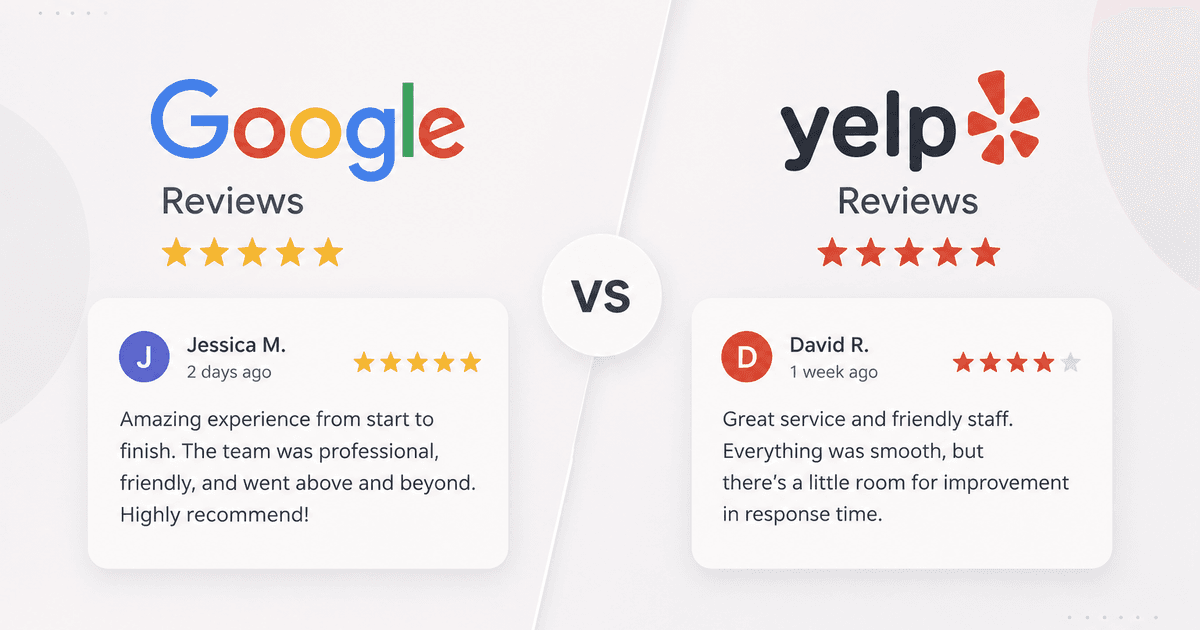
Google Reviews vs. Yelp Reviews: Where Should You Focus First?
Marketing & Growth Associate
On this page▾
If you are deciding whether to focus on Google reviews or Yelp reviews, you are already thinking in the right direction.
But the real issue is not choosing one over the other.
It is the gap between platforms.
Customers do not stay on one platform. They move between Google, Yelp, and others—comparing ratings, reading feedback, and forming opinions based on what they see across all of them.
Meanwhile, businesses are left trying to manage each platform separately.
That disconnect creates a problem: your reputation is spread out, but your management process is fragmented.
Understanding how Google and Yelp differ is the first step. Understanding how to close that gap is what actually improves your results.
Key takeaways
- Google and Yelp serve different roles. Google drives discovery, while Yelp supports deeper evaluation.
- Customers use multiple platforms. Your reputation is not limited to one site.
- The real challenge is fragmentation. Managing reviews separately leads to inefficiency and inconsistency.
- Closing the gap matters more than choosing a platform.
- ReviewShare helps unify your review presence across platforms.
Why this decision matters
Reviews are often the first impression of your business.
According to BrightLocal’s 2026 survey, 97% of consumers read reviews for local businesses, and many check multiple platforms before making a decision.
This behavior creates a clear pattern:
- Customers discover you on Google
- Then validate you on platforms like Yelp
If your presence is strong on one platform but weak or inconsistent on another, it creates doubt. The issue is not visibility alone, it is consistency across platforms.
Google Reviews vs. Yelp Reviews at a glance
Factor | Google Reviews | Yelp Reviews |
|---|---|---|
Primary role | Discovery and visibility | Evaluation and detailed insights |
Where reviews appear | Google Search, Maps, Business Profile | Yelp website and app |
Audience reach | Very broad | More niche but influential in individual industries |
Local SEO impact | Directly affects visibility in search results | Indirect impact through search presence |
Review style | Shorter, quicker feedback | Longer, experience-focused reviews |
Customer behavior | Quick comparison of nearby options | Deeper research before making a decision |
Priority for most businesses | First | Secondary, depending on industry |
The difference is simple: Google helps customers find you. Yelp helps them decide if they trust you.
But customers do not think this way.
They move between platforms, comparing what they see. If your reviews are inconsistent, outdated, or poorly managed on one platform, it affects how they perceive your business overall.
This creates a gap:
- Your reputation exists in multiple places
- Your management process does not
That is where most businesses struggle, not with getting reviews, but with keeping everything aligned.
What is the Solution?
Instead of treating Google and Yelp as separate tasks, the goal should be to manage them as part of one system.
This is where ReviewShare fits naturally into the process.
Challenge across platforms | What happens without a system | How ReviewShare closes the gap |
|---|---|---|
Reviews spread across multiple platforms | Feedback is fragmented and hard to track | All reviews are collected in one dashboard |
Switching between tools | Time is lost managing different interfaces | One place to monitor and respond |
Inconsistent responses | Tone and timing vary across platforms | Centralized management keeps responses consistent |
Missed or delayed reviews | Important feedback can go unnoticed | Real-time visibility across platforms |
Difficulty showcasing reviews | Reviews stay locked within each platform | Reviews can be displayed on your website |
Rather than choosing between Google and Yelp, ReviewShare helps you treat them as part of the same customer journey.
It does not replace either platform, it simply removes the friction between them.
The bottom line
The question is not which platform deserves your attention first, it is how your business shows up across all of them.
Customers do not experience your brand in fragments. They move from Google to Yelp and beyond, forming a single impression based on everything they see.
That means your strategy cannot be platform-specific. It has to be connected.
Google should anchor your visibility. It is where discovery happens, where first impressions are formed, and where a steady stream of recent reviews keeps you relevant.
Yelp should reinforce your credibility. It is where customers slow down, read deeper, and look for signals that your business consistently delivers on its promises.
But neither works in isolation.
What matters is alignment, ensuring your ratings, responses, and overall presence tell the same story everywhere. When that story is consistent, trust builds naturally. When it is not, even strong reviews lose their impact.
FAQs
Should I focus on Google Reviews or Yelp Reviews first?
Start with Google because it directly impacts how customers find you through Search and Maps. Once your Google presence is strong, expand your focus to Yelp, especially if your industry relies on detailed customer experiences like restaurants, salons, or home services.
Why is managing both Google and Yelp important?
Customers rarely rely on a single source. They compare ratings, read reviews across platforms, and look for consistency. A strong presence on only one platform can create doubt if another platform tells a different story. Platforms like ReviewShare are perfect to manage multiple platform reviews in one single dashboard.
What is the biggest challenge with multiple review platforms?
Fragmentation. Reviews are spread across different platforms, making it harder to track feedback, respond consistently, and maintain a unified brand voice. This often leads to missed reviews, delayed responses, and inconsistent customer perception.
How can businesses manage reviews more efficiently?
Instead of switching between platforms, businesses benefit from a centralized system that brings all reviews into one place. This makes it easier to monitor feedback, respond quickly, and maintain consistency across platforms.
Does having reviews on multiple platforms improve trust?
Yes. A consistent presence across platforms reinforces credibility. When customers see similar ratings, recent activity, and thoughtful responses everywhere they look, it strengthens their confidence in your business.