Gen Z Is Changing Restaurant Reviews. Is Your Restaurant Keeping Up?
Marketing & Growth Associate
On this page▾
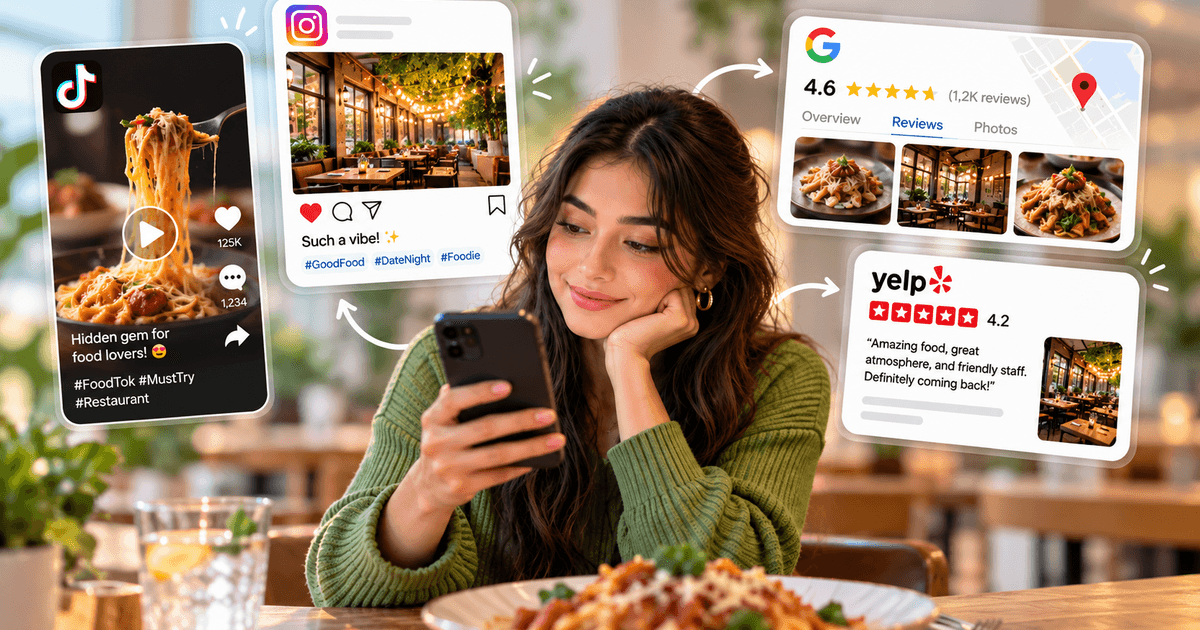
A restaurant catches someone's attention on TikTok. The food looks incredible, the atmosphere feels inviting, and the comments are filled with people tagging their friends. Within seconds, that restaurant becomes a potential weekend plan.
But before making a reservation, the person checks Instagram for more photos, searches Google for ratings, and reads a few Yelp reviews to see whether the experience lives up to the hype.
By the time they're ready to decide, they've visited several platforms, each showing a different part of the restaurant's reputation.
This is how restaurant discovery is evolving, particularly among Gen Z diners. Social media creates curiosity, while customer reviews provide the reassurance that turns curiosity into a dining decision.
For restaurant owners, this shift creates an opportunity. Your customers are already sharing experiences, posting videos, and writing reviews across multiple platforms. The challenge is making that social proof easy to find when someone is deciding where to eat.
The restaurants that understand this changing behavior have an advantage: they don't just attract attention. They give potential customers a clear reason to trust what they've discovered.
How Gen Z Is Changing the Way People Discover Restaurants
Restaurant discovery once followed a relatively predictable path. Someone searched for nearby restaurants, compared ratings, read reviews, and selected a place to eat.
That process still exists, but social media has introduced a different starting point.
For many younger diners, discovering a restaurant happens while watching a food creator, scrolling through Instagram Reels, or seeing a friend's recommendation. They may not even be planning to eat out when a video catches their attention.
A 2025 study conducted by Belle Communication and Nation's Restaurant News, surveying approximately 1,140 Gen Z and millennial consumers in the United States, illustrates this shift:
- 73% reported visiting a restaurant in the previous three months because of a social media review.
- 55% identified social media reviews as the top reason they try a restaurant.
- 43.7% said they turn to social media first for restaurant recommendations.
The research focuses on surveyed younger consumers, including followers of food creators, rather than representing every restaurant customer. Even so, it reveals an important shift: restaurant recommendations are no longer confined to traditional review websites.
TikTok and Instagram Are Becoming Restaurant Discovery Channels
Consider how people interact with restaurant content.
A short TikTok video can introduce a hidden neighborhood café to thousands of potential customers. An Instagram Reel can highlight a restaurant's signature dish, while a customer story can show what the dining experience actually feels like.
Unlike traditional advertisements, these recommendations often come from customers or creators sharing their own experiences.
The appeal is immediate. Viewers can see the food, hear the atmosphere, and observe the restaurant through someone else's perspective.
This visual storytelling makes restaurant discovery more personal. Instead of relying entirely on descriptions or promotional images, prospective diners get a glimpse of what they might experience themselves.
But an appealing video only tells part of the story. It might show a perfectly prepared dish without revealing how the restaurant handles a busy Friday evening, whether portions justify the price, or how consistently customers enjoy their visits.
Those questions often lead people back to traditional restaurant reviews.
Google, Yelp, and TripAdvisor Still Influence the Final Decision
A restaurant's social media presence might generate excitement, but written reviews offer something different: accumulated customer experience.
Google reviews give diners a quick overview of ratings, recent feedback, and local business information. Yelp reviews often provide detailed descriptions of service, food, and overall value. TripAdvisor is particularly relevant for travelers comparing unfamiliar restaurants.
In the same Belle Communication and Nation's Restaurant News research, 38.6% of respondents said they turn to review sites such as Google or Yelp for restaurant recommendations.
That figure is worth considering alongside the 43.7% who said they turn to social media first. Both channels remain relevant to how younger consumers evaluate restaurants.
Someone might discover a new sushi restaurant through a creator but still check Google to see whether recent customers mention long waiting times. Another person might find a restaurant through Google Maps, then visit Instagram to see whether the atmosphere suits a birthday dinner.
These aren't competing behaviors. They're different parts of the same decision.
What Gen Z Actually Looks for in Restaurant Reviews
A five-star rating is useful, but it rarely answers everything a prospective diner wants to know.
People aren't simply deciding whether a restaurant is good. They're deciding whether it's right for a particular occasion, budget, preference, or group.
That distinction explains why the details inside restaurant reviews matter just as much as the overall score.
The Experience Behind the Rating
Consider two restaurants with similar Google ratings.
One has dozens of brief reviews saying "great food" or "highly recommended." The other has customers describing attentive staff, generous portions, vegetarian options, and how well the restaurant accommodated a large group.
Both may appear equally appealing at first glance, but the second provides more useful information for someone planning a specific dining experience.
For a first-time visitor, a review describing what to order, how long the food took to arrive, or whether the restaurant was noisy can be more informative than another five-star rating.
This is particularly important for restaurants trying to attract different types of customers. A café popular with remote workers may want to highlight feedback about seating and atmosphere. A family restaurant benefits from customer experiences involving children, service, and convenience.
The value of a restaurant review lies in how well it answers the questions people have before visiting.
Recent Feedback and Consistency Matter
A viral video captures a moment. A restaurant's review history provides a broader picture.
A glowing recommendation from six months ago may attract attention, but a prospective customer could still want to know whether the restaurant maintains the same standards today.
This is why recent feedback and recurring themes deserve attention.
If customers repeatedly praise the same dishes, hospitality, or dining atmosphere over time, that consistency provides a stronger basis for confidence than one enthusiastic post.
The opposite is also true. Repeated complaints about slow service or incorrect orders reveal issues that a visually appealing social media presence cannot resolve.
Restaurant owners should pay attention to what customers consistently say, not just how many positive reviews they receive.
A useful approach is to examine recent feedback by theme. Are customers discussing food quality, pricing, service, cleanliness, or atmosphere? Which experiences receive the most praise, and which concerns keep appearing?
These patterns offer insight into both customer expectations and operational improvements.
Authenticity Matters More Than a Perfect Reputation
Not every restaurant review needs to be glowing to be useful.
A thoughtful four-star review might explain that the food was excellent but the restaurant was crowded on a Saturday night. For someone looking for a lively atmosphere, that information could actually make the restaurant more appealing.
Similarly, a professional response to criticism can reveal how seriously a restaurant takes customer concerns.
The goal of restaurant reputation management shouldn't be to manufacture a flawless image. It should be to build a credible record of genuine customer experiences.
Restaurants should request honest feedback from customers without offering incentives for favorable ratings or selectively asking only satisfied guests to review them.
This distinction also matters when working with food influencers. A creator's sponsored recommendation and an independent customer review are different forms of social proof. Both can contribute to restaurant marketing, but paid relationships should be disclosed clearly.
For diners, knowing the context behind a recommendation makes it easier to judge how much weight to give it.
The Hidden Problem With Restaurant Reviews: Your Reputation Is Scattered
Imagine a neighborhood Italian restaurant with 600 Google reviews, a strong Yelp profile, several TripAdvisor recommendations, and an Instagram account filled with customer photos.
A local food creator recently featured its handmade pasta, while a customer posted a video praising the staff for organizing a memorable birthday dinner.
The restaurant has plenty of positive customer experiences to showcase.
But someone who discovers the business through Instagram may never see its detailed Google reviews. A visitor reading Yelp might miss the birthday video. Someone browsing the website might find a menu and reservation button but little evidence of what customers actually experience.
Nothing is necessarily wrong with the restaurant's reputation. The problem is that different parts of it are difficult to discover together.
Why More Reviews Don't Automatically Mean More Visibility
Collecting reviews is essential, but a large collection of feedback doesn't guarantee that prospective customers will encounter the most relevant information.
Review platforms organize content according to their own interfaces, sorting options, and display systems. Social platforms prioritize content through feeds and recommendation algorithms.
Restaurants have limited control over which individual customer experiences people encounter first.
A detailed testimonial about private dining might be buried beneath hundreds of general reviews. A useful customer video might receive attention for a few days before becoming difficult to find.
This creates a gap between the reputation a restaurant has earned and the reputation a potential customer actually sees.
It's a particularly important distinction for restaurants with multiple strengths. A business might be known for brunch, private events, takeout, and family dining, yet a prospective customer may encounter feedback about only one of those experiences.
Organizing existing social proof around what customers want to know gives those experiences greater visibility.
The Cost of Making Customers Search for Reassurance
Consider a potential customer planning dinner with friends.
They discover a restaurant on TikTok, visit Instagram, check its Google rating, browse Yelp, and eventually return to the website to look for a menu.
During that process, they're likely to encounter competing restaurants, unrelated content, and recommendations that pull their attention elsewhere.
This doesn't mean visiting multiple platforms automatically causes someone to abandon a restaurant. Many customers actively want independent sources before deciding.
But there is a difference between giving people access to independent reviews and requiring them to search for every piece of information themselves.
Restaurants can make the journey more convenient by presenting relevant customer experiences together while preserving their original context.
For example, a diner exploring a restaurant's website could see written reviews about service alongside customer photos of the dining area and a video featuring a signature dish.
That combination offers a more complete impression without replacing the original review platforms.
What Restaurant Owners Can Learn From Gen Z's Review Habits
The most useful lesson from changing restaurant discovery habits isn't that every restaurant needs to become famous on TikTok.
It's that customer opinions now travel through more formats and channels than before.
A review can be a paragraph on Google, a detailed Yelp recommendation, an Instagram story, or a short video from a local food creator. Each format communicates something different.
Restaurants that understand those differences can use customer feedback more thoughtfully.
Match Customer Experiences to the Questions Diners Ask
A restaurant's most persuasive review isn't necessarily the one with the most enthusiastic language. It's often the one that answers a specific concern.
Someone planning an anniversary dinner might look for feedback about atmosphere, attentive service, and special occasions. A tourist may prioritize location, signature dishes, and whether the restaurant lives up to its reputation.
A family visiting for the first time could be interested in portion sizes, child-friendly options, and seating arrangements.
Instead of treating all reviews as interchangeable, restaurant owners can identify the experiences that matter most to their customers.
For instance, a restaurant promoting private dining could feature authentic testimonials from previous group bookings. A brunch café could showcase customer posts featuring its popular dishes alongside reviews discussing weekend service.
This approach makes customer feedback more useful because it connects the experience being promoted with evidence from people who have already enjoyed it.
Use Reviews to Understand What Customers Actually Remember
Restaurant reviews are also a source of operational insight.
Customers often describe details that business owners don't think to emphasize in their marketing.
A restaurant might invest heavily in promoting a new menu, while its reviews consistently praise the friendly staff or welcoming atmosphere. A café may be known internally for specialty coffee, but customers might repeatedly mention its quiet seating and convenient location.
These patterns reveal what customers value enough to discuss publicly.
Reviewing feedback across platforms can uncover differences, too. Google reviews may highlight convenience and service, while Instagram posts emphasize presentation and atmosphere.
Rather than assuming one platform tells the entire story, restaurants should examine how customer perceptions vary across channels.
Those insights can influence website messaging, promotional campaigns, menu descriptions, and the customer experience itself.
Don't Let a Viral Moment Define the Entire Business
Social media attention can be valuable, especially for independent restaurants with limited advertising budgets.
A popular video might introduce a restaurant to an audience that would never have discovered it through local search.
But viral attention also creates expectations.
If a video focuses on an oversized dessert or an unusual interior, viewers may arrive expecting that specific experience. If the restaurant's broader reputation tells a different story, disappointment becomes more likely.
This is another reason to maintain a strong foundation of customer reviews.
Written feedback provides context around food quality, service, and consistency that a short video may not capture.
The strongest restaurant marketing connects the excitement of social discovery with the reliability of real customer experiences.
Bringing Restaurant Reviews and Social Proof Into One Experience
By this point, the opportunity becomes clearer.
Restaurants don't need to choose between Google reviews, Yelp recommendations, TripAdvisor feedback, and social media content. They need a practical way to make these different customer experiences work together.
That's the idea behind ReviewShare.
ReviewShare brings reviews from supported platforms, direct customer testimonials, and supported social content into a single branded Review Page. Instead of relying on separate links for different review sources, restaurants can showcase selected customer experiences in one organized place.
For a restaurant, that might mean displaying Google reviews about consistent service, Yelp testimonials describing favorite dishes, TripAdvisor recommendations from visitors, and Instagram or YouTube content showing the dining experience.
The original platforms still matter. A centralized Review Page simply gives customers another way to explore that information together.
A Single Link That Makes Your Reputation Easier to Explore
Consider the role of a restaurant's Instagram bio.
A visitor who discovers the business through a Reel may want to learn more before booking a table. A link to a branded Review Page gives them access to different forms of customer feedback without requiring them to search for each one individually.
The same page can be shared through other marketing channels, including email campaigns and promotional materials.
For restaurants with active social accounts, this creates a more useful connection between content that attracts attention and reviews that support customer confidence.
It also gives older customer experiences a longer marketing life. A thoughtful testimonial or memorable customer post doesn't need to disappear simply because it is no longer recent content in a social feed.
Your Website Should Show More Than What You Say About Yourself
Restaurant websites often focus on menus, opening hours, location, and reservations. Those details are necessary, but they tell visitors relatively little about what dining there actually feels like.
Customer feedback adds a perspective the business cannot provide on its own.
ReviewShare embeddable widgets allow restaurants to display selected reviews directly on their websites. A homepage might feature general customer experiences, while a private dining page could highlight relevant testimonials from previous events.
Restaurants can also organize reviews into groups to showcase different experiences, such as brunch, hospitality, or special occasions.
The purpose isn't to overwhelm visitors with dozens of testimonials. It's to make relevant social proof available where people are already evaluating the business.
A few detailed, authentic reviews often communicate more than a large collection of generic praise.
Restaurant Reviews Are Also a Long-Term Marketing Asset
One of the most overlooked opportunities in restaurant marketing is what happens after a customer leaves a review.
A customer spends time describing a memorable dinner, praising a staff member, or recommending a particular dish. That feedback contributes to the restaurant's online reputation, but it can also inform how the business presents itself to future customers.
For example, a restaurant launching a new brunch menu might already have customer testimonials discussing its breakfast dishes. A business promoting private events might have feedback from previous birthday celebrations or corporate dinners.
Rather than starting each campaign with entirely new promotional claims, restaurants can draw on relevant experiences customers have already shared.
This is especially useful for smaller businesses that don't have dedicated content production teams.
However, reusing customer content requires care. Public availability doesn't automatically grant permission to reproduce photographs, videos, or written content in advertising. Restaurants should respect platform rules, attribution requirements, and any necessary permissions.
The most effective approach is to treat reviews as genuine customer contributions, not advertising copy that can be rewritten to suit a campaign.
A consistent process for collecting, organizing, and responsibly showcasing those experiences gives restaurants a library of social proof that grows alongside the business.
How to Know Whether Your Restaurant's Reviews Are Making a Difference
Restaurant owners often track review counts, average ratings, and social media engagement. These numbers are useful, but they don't explain the entire customer journey.
A restaurant might receive thousands of video views without knowing whether viewers explored its website. Another might have excellent Google ratings but little idea which customer experiences resonate most with prospective diners.
To understand the value of reputation marketing, restaurants need to look beyond the number of reviews collected.
Start with the places where people discover the business. Are visitors arriving through Google Search, Google Maps, social profiles, or referral links? Which website pages receive traffic from those sources?
Then consider what happens after visitors encounter customer reviews. Do they continue to the menu, visit the reservation page, or click through to ordering information?
These patterns won't always prove that a particular review caused a booking. A customer may discover a restaurant on Instagram, read reviews several days later, and eventually make a reservation through another channel.
Still, tracking referral traffic, relevant link clicks, and reservation activity can reveal whether customers are moving through the intended journey.
Restaurants can also test different placements for their social proof. A review section near reservation information might be more useful than one hidden at the bottom of a homepage. Testimonials about group dining may perform better on a private events page than on a general menu page.
The goal is to learn which customer experiences are useful at different stages of the decision, then make those experiences easier to find.
The Future of Restaurant Reviews Isn't Social Media Versus Google
Gen Z is changing how restaurants are discovered, but that doesn't make traditional review platforms obsolete.
A TikTok video can introduce a restaurant. Instagram can show its atmosphere. Google, Yelp, and TripAdvisor can provide a broader record of customer experiences. A restaurant website can bring those impressions together and make the next step easier.
The opportunity for restaurant owners lies in understanding how these channels complement one another.
Customers don't experience your reputation as separate marketing departments or platform accounts. They encounter individual pieces of information and use them to form an opinion about your business.
When those pieces are disconnected, potential diners must do more work to understand what makes your restaurant worth visiting.
When authentic reviews, testimonials, and social content are easier to explore together, your reputation becomes more accessible and useful.
ReviewShare gives restaurants a way to connect those experiences through a branded, shareable Review Page and embeddable website widgets.
Your customers are already telling stories about your restaurant. The next step is making sure those stories are easy to discover when someone is deciding where to eat.
FAQs
How does Gen Z use restaurant reviews to choose where to eat?
Gen Z diners use a combination of social media recommendations, Google reviews, Yelp ratings, customer photos, and videos to evaluate restaurants. Social content often introduces new places, while traditional reviews provide details about food quality, service, pricing, and consistency.
Are Google and Yelp reviews still important for restaurants?
Yes. Google and Yelp remain important sources of restaurant feedback. Google reviews also contribute to local search visibility, while detailed customer reviews give prospective diners information that short social media videos may not provide. Restaurants benefit from maintaining both traditional review profiles and an active social media presence.
What types of restaurant reviews are most useful to customers?
Detailed, recent, and authentic reviews are especially useful because they answer practical questions about the dining experience. Feedback about food quality, service, atmosphere, pricing, dietary options, and special occasions provides more context than a star rating alone.
How can restaurants bring reviews from different platforms together?
ReviewShare allows restaurants to bring supported platform reviews, customer testimonials, and social content into a single branded Review Page. Businesses can organize selected experiences, share the page through a single link, and display reviews on their websites using embeddable widgets.
How can restaurants turn online reviews into a marketing asset?
Restaurants can organize genuine customer feedback around relevant experiences, showcase testimonials on their websites, and share selected reviews through appropriate marketing channels. Bringing customer experiences together makes a restaurant's reputation more accessible and gives prospective diners useful information before they decide to visit.