
Linktree for Reviews: How to Share Customer Reviews and Social Proof With One Link
Marketing & Growth Associate
On this page▾
A potential customer discovers your business through an Instagram post. They like what they see, visit your profile, and click the link in your bio.
But they're not ready to book an appointment or request a quote just yet.
They want to know what previous customers have experienced. Was the service worth the money? Did the business deliver what it promised? Would other people recommend it?
Your website explains what you offer, and your social media shows what you do. But neither necessarily answers those questions as convincingly as someone who has already worked with you.
This is where the idea of a Linktree for reviews becomes interesting.
Linktree popularized the idea of giving people one link to explore multiple online destinations. But for businesses that depend on customer trust, there's an opportunity to make that link do something more specific: help visitors evaluate the business through real customer experiences.
ReviewShare brings customer reviews, testimonials, and social proof together on one branded, shareable page, giving businesses a dedicated way to present their reputation wherever potential customers discover them.
The bigger question, however, isn't how many reviews you can fit behind one link. It's what those reviews help someone understand before making a decision.
What Is a Linktree for Reviews?
A Linktree for reviews is a dedicated page that allows businesses to share customer feedback and social proof through one link.
The concept is similar to a traditional link-in-bio page, but the purpose is different.
A typical Linktree might direct visitors to a business website, booking platform, online store, and social media profiles. A review-focused page puts customer experiences at the center of that interaction.
For example, a real estate agent might have recommendations on Zillow, Google reviews from previous clients, and video testimonials from homeowners. Each platform contributes something to the agent's reputation.
A dedicated review page brings those experiences into one accessible destination.
But there's an important distinction between simply collecting reviews and making them useful.
Imagine opening a page containing 150 five-star reviews. The rating is impressive, but if you're looking for an agent to help sell your first home, how many of those reviews actually address your concerns?
A review about purchasing an investment property might be less relevant to you than a detailed testimonial from another first-time seller.
The value of a review page isn't just having everything in one place. It's making the right customer experiences easier to find.
The Problem With Sending Interested Customers Straight to a Booking Page
Businesses often design their online presence around getting visitors to take action.
An Instagram bio leads to a website. The website leads to a service page. The service page encourages visitors to book, call, or request a quote.
That journey makes sense for someone who has already decided to buy.
But what about someone who is still evaluating their options?
Consider a homeowner looking for a professional cleaning company.
They discover a business through a short Instagram video showing a completed deep-cleaning project. The results look impressive, so they visit the company's profile.
The bio includes a booking link.
At this point, the homeowner might not be ready to schedule anything. They still have questions about reliability, pricing, professionalism, and whether the company has experience cleaning homes like theirs.
Sending that visitor directly to a booking form assumes they've already made their decision.
A review page offers another route.
Instead of immediately asking for a commitment, the business gives visitors access to previous customer experiences that help them evaluate the service.
A testimonial describing how the cleaners handled a difficult move-out job might answer a concern that a polished service description cannot.
This doesn't mean every visitor should see reviews before reaching a booking page. Someone returning to schedule another appointment probably wants the fastest route to booking.
The point is to recognize that not every click represents the same level of readiness.
Your online links should support people who are ready to act and those who still need information.
Why the Most Useful Review Isn't Always the Highest-Rated One
Businesses naturally want to showcase their strongest reviews. Five-star ratings, enthusiastic recommendations, and positive testimonials all contribute to a favorable impression.
But a review becomes particularly useful when it addresses something a potential customer is uncertain about.
Consider these two fictional reviews for a cleaning company:
"Excellent service. Highly recommended!"
And:
"We booked a move-out cleaning with only two days' notice. The team arrived on time, explained what was included, and completed the job before our final inspection."
Both are positive. The second, however, provides details about scheduling, communication, and the service delivered.
For someone facing a tight moving deadline, those details are directly relevant.
This is why a useful review-sharing strategy should consider three things.
Relevance matters more than volume alone
A large collection of positive reviews establishes a broad reputation. But when customers have specific needs, relevant experiences help them evaluate whether a business is suitable for them.
A salon customer considering hair coloring might want to read testimonials about coloring services rather than general haircut reviews.
A homeowner planning a renovation might want feedback about similar projects rather than unrelated repairs.
The more closely a review reflects someone's situation, the more useful it becomes in their decision.
Specific experiences provide more context than generic praise
A star rating communicates an overall impression, but the accompanying explanation often provides the information customers need.
Comments about communication, turnaround time, service quality, and problem-solving help prospective customers understand what working with a business might actually involve.
That doesn't make short reviews worthless. It means businesses should think beyond ratings when deciding which customer experiences to highlight.
Credibility depends on authenticity
A review page shouldn't look like a collection of advertising slogans.
Authentic feedback often contains specific details, personal experiences, and different writing styles. Those qualities make it easier for readers to understand that the comments came from real customers.
Businesses should preserve the original meaning of testimonials, identify their sources where appropriate, and avoid presenting edited or selectively altered feedback as complete customer statements.
A trustworthy review page doesn't need every review to sound perfect.
It needs the experiences it presents to be genuine.
From Scattered Reviews to a More Useful Customer Journey
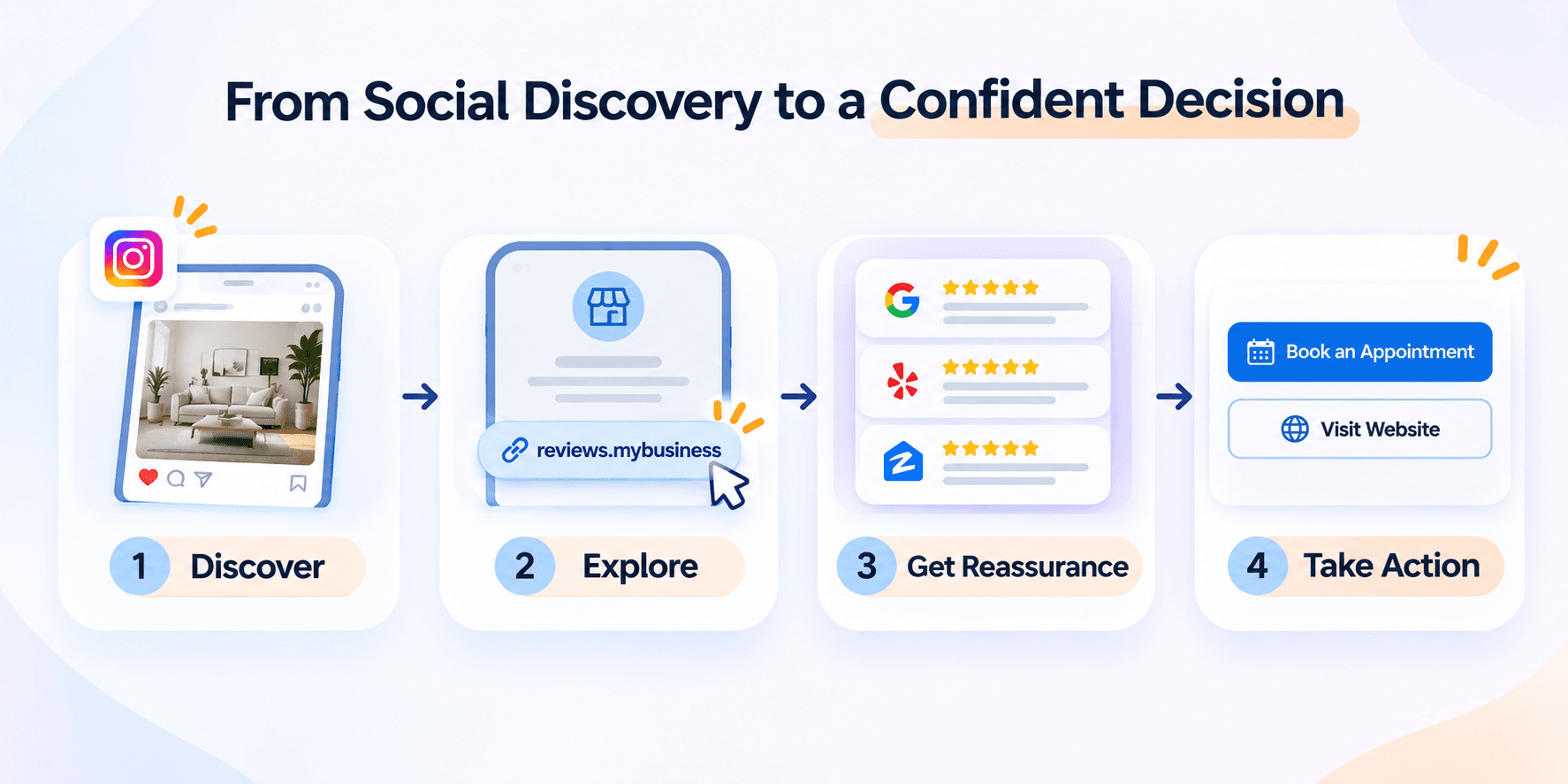
This is where ReviewShare becomes more than another link-in-bio destination.
Businesses already receive customer feedback through platforms such as Google, Yelp, Zillow, TripAdvisor, and Facebook. They may also have video testimonials, social media recommendations, and customer-created content.
ReviewShare allows businesses to bring these different forms of social proof into a branded Proof Page.
More importantly, its Review Groups feature allows businesses to organize feedback around particular services, products, or locations.
Consider our cleaning company example.
Instead of presenting every review in one long feed, the business could organize its customer feedback into residential cleaning, deep cleaning, and move-out cleaning.
Someone interested in move-out cleaning can then explore experiences from customers who booked that specific service.
The company can also include relevant testimonials and social content, giving visitors more context about the work.
Once the customer has found the information they need, the page can direct them toward the business's website or another appropriate next step.
The process is straightforward, but the reasoning behind it matters.
The review page isn't simply a destination for positive feedback. It's a connection between discovering a business and deciding whether to contact it.
Linktree vs. ReviewShare: Why the Purpose of the Link Matters
Linktree and ReviewShare aren't identical products competing to solve exactly the same problem.
Linktree is designed to organize multiple online destinations. It also supports displaying Google reviews, so businesses can include social proof alongside their other links.
ReviewShare focuses specifically on collecting, organizing, and showcasing customer reviews and testimonials from multiple sources.
Linktree | ReviewShare | |
Primary purpose | Direct visitors to online destinations | Present customer reviews and social proof |
Review capabilities | Google Reviews display | Reviews from multiple supported platforms |
Content organization | Links and general content | Reviews grouped by service, product, or location |
Customer experience | Explore different destinations | Explore relevant customer feedback |
Website integration | Links and content integrations | Dedicated review display widgets |
For a creator sharing videos, products, and newsletters, a general link-in-bio page might be the most useful starting point.
For a local business whose customers want reassurance before booking, a dedicated review-sharing page addresses a more specific need.
The two can also work together. A business already using Linktree can include its ReviewShare page as one of its destinations.
The better question isn't which platform has more features. It's what you want visitors to understand after clicking your link.
Where Should Businesses Share Their Review Link?
Once you understand the role of customer feedback in the decision-making process, choosing where to share your review page becomes easier.
An Instagram or TikTok bio is useful when people discover your business through content but want to learn more before contacting you.
A service inquiry or quotation email is another opportunity. Someone comparing cleaning companies, real estate agents, or home service providers may appreciate access to relevant customer experiences alongside the information they've requested.
On a business website, customer reviews can support service descriptions and booking pages. ReviewShare's carousel, bento, and marquee widgets allow businesses to showcase feedback directly within their website content.
The key is context.
A review link should appear where customers are likely to have questions about your business, not simply everywhere you can paste a URL.
What Businesses Should Measure Beyond Review Page Visits
Getting people to click a review link is useful, but clicks alone don't tell you whether the page is doing its job.
A more meaningful question is what visitors do after exploring the feedback.
Do they continue to your website? Do they contact your business? Are they asking more informed questions during inquiries? Are certain testimonials frequently mentioned in conversations?
Businesses can examine these signals through website analytics, tracked links, and customer conversations where available.
For example, a cleaning company could use a tagged website link from its review page to understand how many visitors continue to its booking page.
That still wouldn't prove the reviews caused a booking. But it would provide a clearer picture of how the review page fits into the customer journey.
A business can also ask new customers what information helped them feel comfortable reaching out.
The objective isn't to turn every review into a measurable sale. It's to understand whether your customer feedback is accessible, relevant, and useful when people are evaluating your business.
Create your ReviewShare Proof Page
FAQs
1. Is there a Linktree specifically for customer reviews?
Yes. ReviewShare provides a dedicated Proof Page for bringing customer reviews, testimonials, and social proof into one branded, shareable destination.
2. Can I add Google reviews to Linktree?
Yes. Linktree offers a Google Reviews feature that allows businesses to display recent or selected Google reviews on their page.
3. Can I share Google, Yelp, and Zillow reviews through one link?
Yes. ReviewShare supports importing reviews from Google, Yelp, Zillow, and other supported platforms so businesses can showcase customer feedback through one Proof Page.
4. Can I use ReviewShare in my Instagram bio?
Yes. Businesses can add their ReviewShare link to an Instagram bio, allowing visitors to explore customer reviews and testimonials directly from their profile.
5. Do I need to replace Linktree to use ReviewShare?
No. You can continue using Linktree for your broader online destinations and add ReviewShare as a dedicated link for customer reviews and social proof.
Make Your Customer Reviews Part of the Decision, Not Just the Display
Businesses spend considerable effort encouraging customers to leave reviews. But once those reviews are published, they're often left on the platforms where they were originally collected.
That's a missed opportunity to make customer experiences more accessible during future customer interactions.
A Linktree-style approach offers a simple starting point: give people one link to explore your reputation.
But the real opportunity goes further.
By presenting relevant reviews, detailed testimonials, and authentic customer experiences, businesses can help potential customers answer the questions that matter before making a decision.
ReviewShare makes that approach practical by bringing customer reviews and social proof together in one branded Proof Page.
Because sometimes the most useful thing you can share with a potential customer isn't another description of your business.
It's the experience of someone who has already chosen you.