ReviewShare: A Senja Alternative for Reviews & Social Proof in 2027
Marketing & Growth Associate
On this page▾
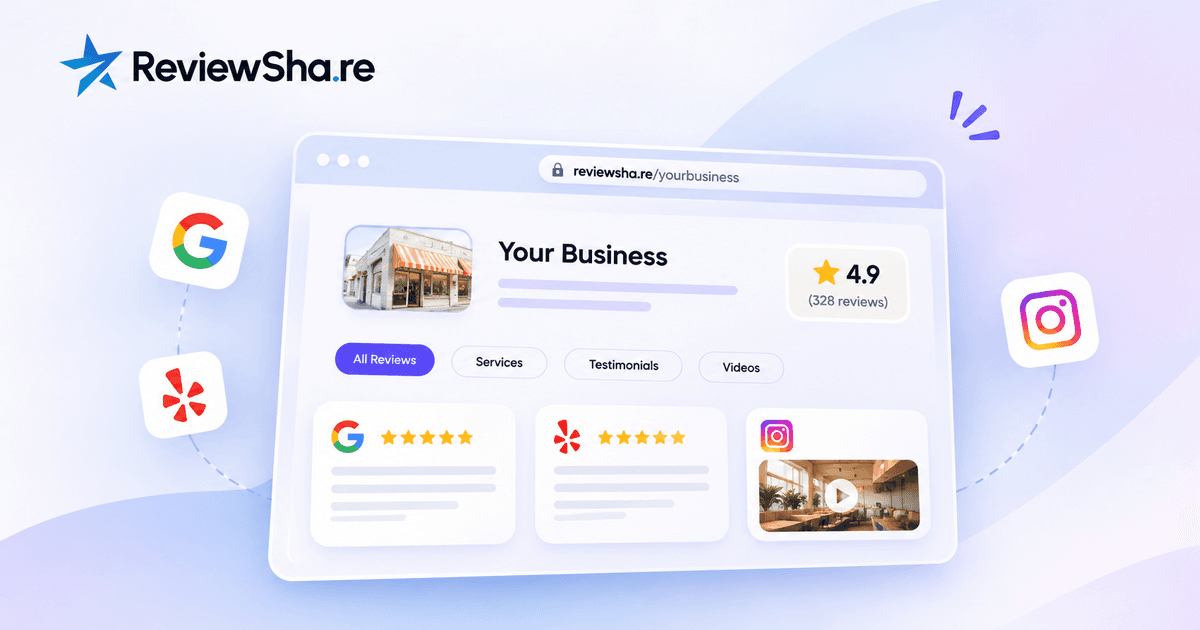
If you're looking for a Senja alternative, you probably want a simpler way to collect, organize, and showcase customer reviews. ReviewShare brings reviews, testimonials, and social content together in one shareable link, making it easier for local businesses to showcase their social proof wherever potential customers are looking.
In this article, we'll explore how ReviewShare compares with Senja, what each platform offers, and what local businesses should consider before choosing the right social proof platform.
Why Businesses Need More Than a Testimonial Collection Tool
A positive review is valuable, but its usefulness depends on whether potential customers encounter it.
Consider a home cleaning company with 180 Google reviews, several detailed Yelp recommendations, and customer testimonials on its website.
Someone searching on Google might see its star rating. A visitor arriving through Instagram might only see its recent posts. A customer reading its move-out cleaning page might never encounter feedback about that particular service.
The business has social proof, but customers experience only fragments of it.
This is where testimonial management and reputation presentation begin to overlap.
Traditional testimonial tools focus on collecting, managing, and displaying customer feedback. Those functions remain important. But businesses also need to think about how reviews move through the customer journey.
A potential customer might discover a business through search, compare services on its website, and ask for more information through email. Each interaction creates an opportunity to present relevant customer experiences.
For local businesses especially, the objective should be straightforward: make authentic feedback easy to find without asking customers to search across several platforms.
ReviewShare is an Alternative Built Around Your Business Reputation
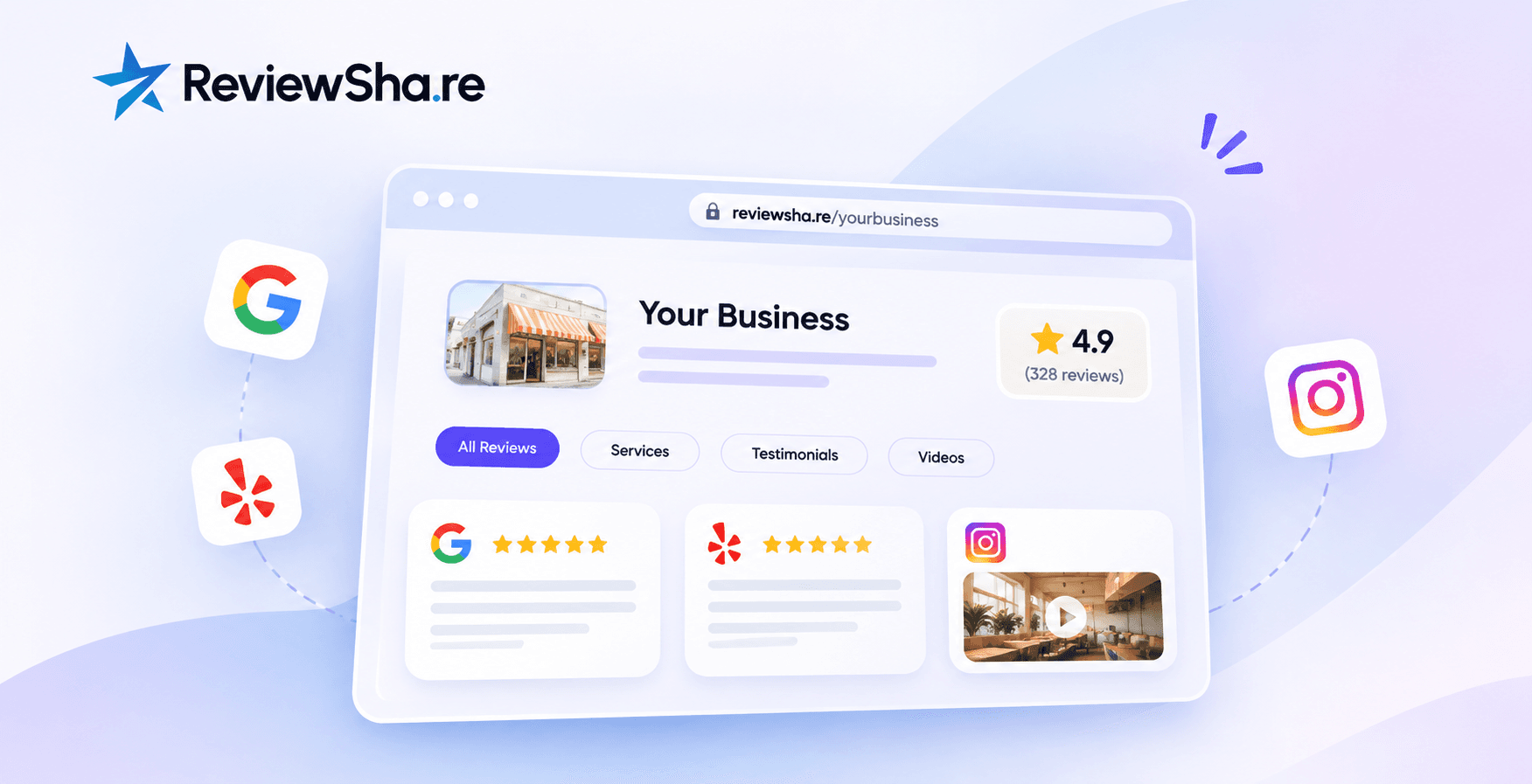
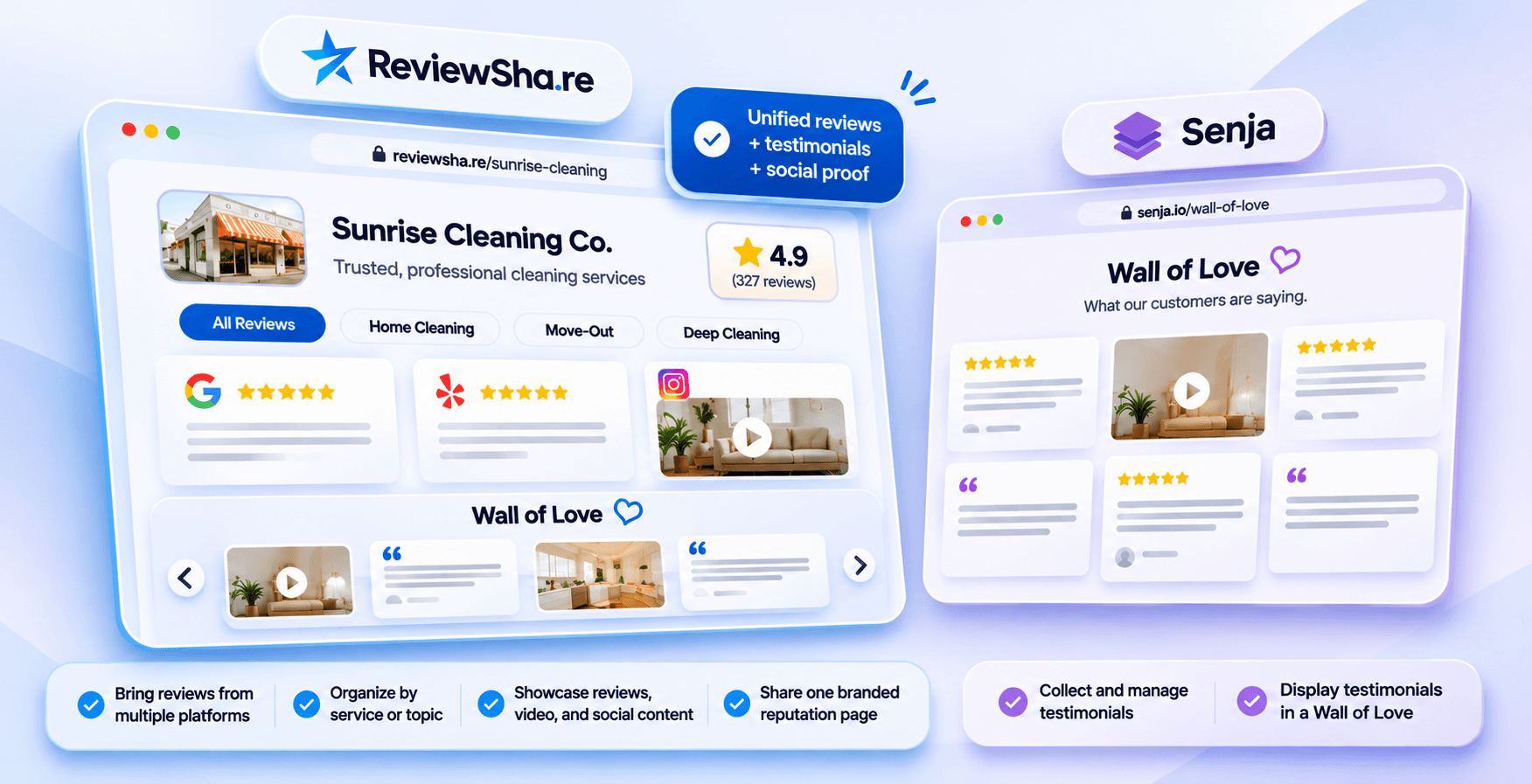
ReviewShare is a customer review and social proof platform that brings reviews, testimonials, and selected social content into one branded, shareable page.
Instead of treating every review platform as a separate destination, ReviewShare gives businesses a central place to present their customer experiences.
A restaurant, for example, might have Google ratings, Yelp feedback, and customer-created Instagram content. ReviewShare allows the business to bring those experiences into a more connected presentation.
The resulting page can be shared through social media, email, websites, and direct customer conversations.
For businesses that offer multiple services, Review Groups provide another layer of organization, allowing testimonials to be presented around particular services or customer needs.
ReviewShare also supports website widgets, direct review collection, and branded presentation options.
The platform's purpose is not to replace Google, Yelp, or other review sources. Those platforms remain important places where customers discover businesses and share their opinions.
Instead, ReviewShare makes existing customer feedback more accessible and useful across the business's own marketing channels.
What Makes ReviewShare Different?
The distinction is in how businesses are encouraged to use their customer reviews.
ReviewShare connects three activities that are often managed separately:
- Collect: Gather customer feedback through review forms, shareable links, QR codes, and invitations.
- Organize: Bring existing reviews together and group customer experiences around relevant services or topics.
- Share: Present reviews through a branded page, website widgets, and links that fit into everyday customer interactions.
A business doesn't need to start from zero. Existing customer experiences can become part of its reputation presentation.
That makes ReviewShare particularly relevant to businesses whose reviews already exist across multiple platforms.
Senja vs ReviewShare: Which Fits Your Business Better?
Senja is an established testimonial management platform with tools for collecting written and video testimonials, importing reviews, organizing feedback, and creating website displays.
ReviewShare offers several overlapping capabilities but emphasizes a branded reputation experience for businesses that want to bring customer reviews and social proof into one destination.
The comparison below focuses on practical uses rather than declaring one platform universally better.
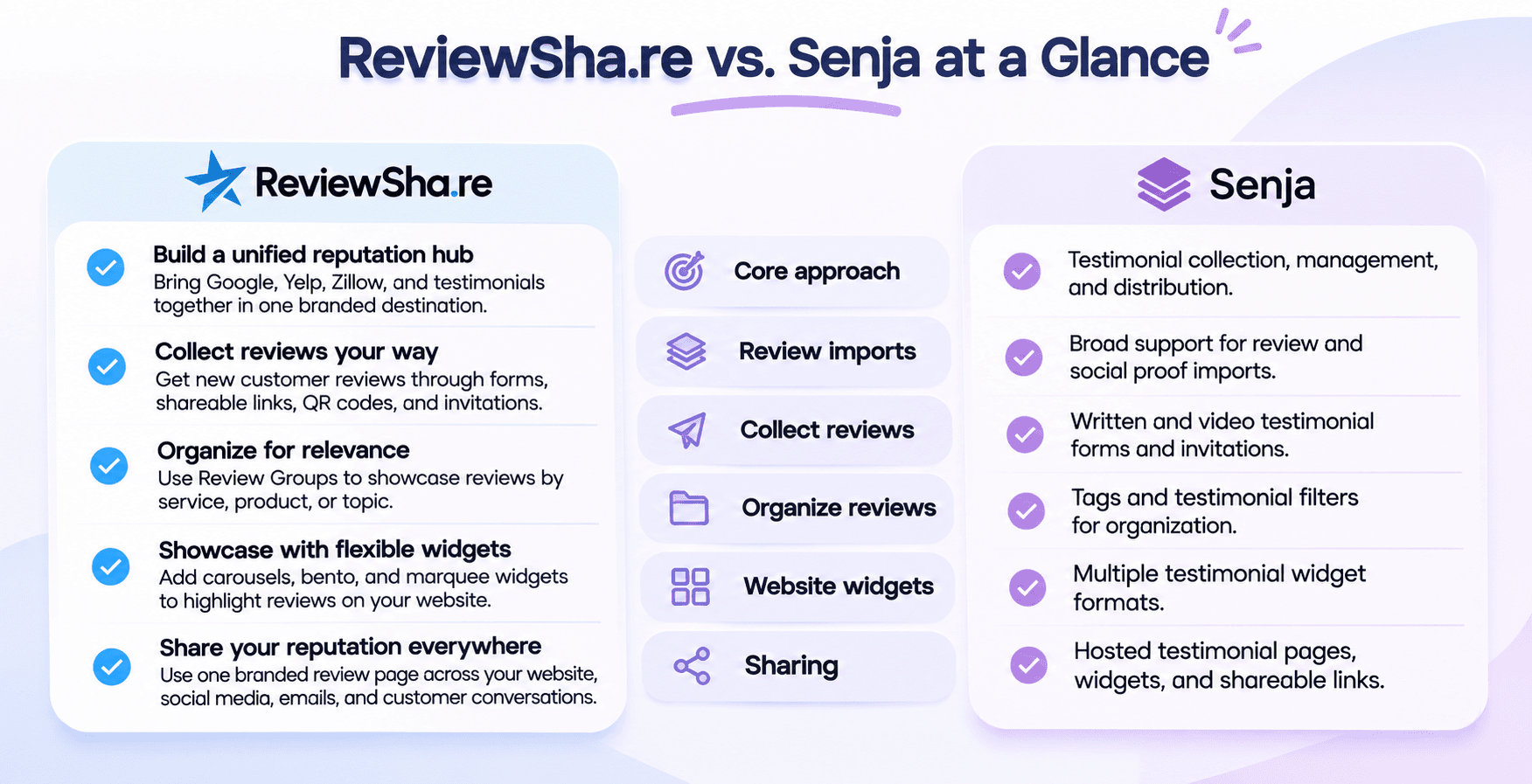
Both platforms can collect, organize, and display social proof. Senja also supports hosted pages, tagging, and review imports, so these aren't exclusive ReviewShare features.
The choice comes down to the workflow a business wants to prioritize.
For teams heavily focused on testimonial campaigns, video collection, and producing different forms of marketing content from testimonials, Senja deserves consideration.
For local businesses looking for a straightforward way to present reviews from different platforms, organize feedback by service, and share their reputation through one branded destination, ReviewShare offers a relevant alternative.
How ReviewShare Turns Existing Reviews Into Useful Social Proof
Collecting more customer reviews is often the first recommendation businesses receive when trying to strengthen their online reputation.
But a business with hundreds of reviews can still struggle to make those experiences visible outside the platforms where they were originally posted.
ReviewShare addresses that problem through a combination of review aggregation, organization, and sharing.
Bring Google, Yelp, and Other Reviews Together
Imagine a restaurant that receives most of its reviews through Google and Yelp.
Those platforms are useful for discovery, but a customer arriving through an Instagram profile or promotional email might not visit either one.
With ReviewShare, the restaurant can direct visitors to a branded page containing customer experiences from multiple sources.
Instead of asking someone to check Google, then Yelp, then Instagram, the business offers one starting point.
This approach also works for real estate agents using Google and Zillow reviews, fitness studios sharing member experiences, and service providers with feedback across different directories.
The original review platforms remain part of the business's reputation. ReviewShare provides an additional way to present that reputation to potential customers.
Make Testimonials Relevant to Individual Services
Not all positive feedback answers the same customer question.
Consider a cleaning company offering residential cleaning, deep cleaning, carpet cleaning, and move-out services.
A customer looking for move-out cleaning wants to know whether the team arrives on time, handles difficult cleaning tasks, and delivers the expected results.
A general testimonial praising friendly staff might be encouraging, but it doesn't answer those specific concerns.
ReviewShare's Review Groups let businesses organize testimonials around relevant services or topics.
For a real estate professional, those groups might include first-time buyers, home sellers, and relocation clients.
For a salon, they could cover hair coloring, bridal styling, and other specialized services.
This organization makes it easier to present feedback that matches what a potential customer is actually considering.
Use Reviews Where Customers Make Decisions
A dedicated testimonial page is useful, but customers don't always begin their journey there.
They might first encounter your business on a service page, through a social media profile, or in a conversation with your team.
ReviewShare supports different ways to bring customer feedback into those interactions.
Website widgets can display selected reviews without requiring visitors to open a separate page. A branded review link can be included in emails, social profiles, and direct messages.
For offline interactions, QR codes provide a way to connect printed materials with a digital review destination.
The objective isn't to display every review everywhere. It's to make the most relevant experiences accessible at the right moment.
Keep the Review Experience Connected to Your Brand
Customers moving between a business website and an unrelated third-party page can experience a disconnect.
ReviewShare's branded page allows businesses to present their reputation using their own identity, including branding and visual customization.
That creates a more consistent experience between the business's marketing materials and its customer reviews.
A branded reputation page also gives businesses a reusable destination rather than requiring a different review link for every marketing channel.
More Reviews Don't Always Mean Better Review Visibility
Consider two local businesses offering similar services.
Business A has accumulated 300 positive reviews across several platforms. Its website displays a few old testimonials, and customers must visit individual review platforms to explore recent experiences.
Business B has 120 reviews. It organizes feedback by service, displays relevant testimonials on important pages, and includes a branded review link in customer communications.
Business A has more reviews, but Business B has made its customer feedback easier to encounter.
This doesn't mean Business B will automatically attract more customers. Review quantity, recency, ratings, service quality, pricing, and many other factors still influence decisions.
The example highlights a distinction worth understanding: having social proof and making social proof accessible are different tasks.
Businesses should evaluate their review strategy through three questions:
- Can potential customers find our reviews without unnecessary effort?
- Do those reviews answer questions about the specific service they're considering?
- Are we making customer experiences visible across our important marketing channels?
If the answer to any of these is no, collecting more reviews isn't the only possible improvement.
Better organization and distribution may be equally worthwhile.
How to Build a Review Strategy With ReviewShare
Businesses don't need a complicated marketing campaign to begin using customer feedback more effectively.
A practical approach starts with existing reviews and the places where customers already interact with the business.
Step 1: Identify Your Review Sources
Start with the platforms where customers currently leave feedback.
For a restaurant, these might include Google and Yelp. A real estate professional might rely on Google and Zillow, while a salon could have Google reviews and customer experiences shared through Instagram.
Look beyond the total number of reviews. Consider which platforms contain detailed, recent, and relevant feedback.
Step 2: Create a Branded Reputation Page
Bring supported review sources and testimonials into ReviewShare.
Customize the page to reflect your business identity and make it easy for visitors to understand what services you offer.
The objective is a clear presentation of genuine customer experiences, not an overwhelming collection of every available comment.
Step 3: Organize Reviews by Customer Interest
Use Review Groups to separate feedback around services or customer needs.
A business offering several services should avoid treating every testimonial as equally relevant to every visitor.
Prioritize experiences that address common customer questions, such as reliability, communication, service quality, and results.
Step 4: Place Reviews Across Important Touchpoints
Add relevant review widgets to your website and include your branded ReviewShare link in appropriate marketing channels.
Start with the places that receive meaningful customer attention, such as service pages, email inquiries, and social media profiles.
Check the mobile experience to ensure customers can read and navigate reviews comfortably.
Step 5: Keep Collecting Authentic Feedback
Existing reviews provide a starting point, but new customer experiences keep your reputation current.
Use appropriate review requests after completing a service or reaching a meaningful customer milestone.
Keep requests neutral and avoid selectively soliciting only positive feedback. Follow the review policies of the platforms involved.
Over time, review collection and review visibility should become part of the same process.
FAQs
1. Is ReviewShare a good Senja alternative for small businesses?
ReviewShare is worth considering for small businesses that want to combine existing customer reviews, organize testimonials by service, and share their reputation through a branded page.
Senja also offers review imports, hosted pages, and widgets. Businesses should compare the specific features and workflows they need rather than assume one platform is better for every situation.
2. Can I display Google reviews and Yelp testimonials together without losing their original sources?
ReviewShare supports bringing reviews from platforms including Google and Yelp into one branded presentation.
Businesses should preserve accurate attribution and avoid changing feedback in ways that misrepresent the customer's experience. Review reuse must also follow the applicable policies of each source platform.
3. What is the best way to use customer reviews on a service business website?
Place testimonials where they answer specific customer questions.
For example, a cleaning company's move-out service page should feature feedback about move-out cleaning rather than unrelated services.
Use website widgets for relevant feedback and a branded review page when visitors want to explore more customer experiences.
4. Do I need a separate Google reviews widget if I already have a ReviewShare page?
Not necessarily. A dedicated ReviewShare page and an embedded widget serve different purposes.
The branded page provides a broader destination for customer reviews, while a widget displays selected feedback within an existing website page.
Using both gives businesses flexibility to present reviews where they're most useful.
5. How do I turn customer reviews into social proof that attracts more local customers?
Begin by identifying where potential customers evaluate your business, such as Google, your website, social media, and direct inquiries.
Make relevant reviews accessible at those touchpoints, organize testimonials around individual services, and provide a clear next step for contacting or booking your business.
ReviewShare supports this approach by bringing customer experiences into a branded destination that businesses can share across their marketing channels.