
Getting Great Reviews but Not More Customers? Here's How to Put Your Social Proof to Work
Marketing & Growth Associate
On this page▾
Customer reviews build credibility, but their real value comes from how businesses use them. Learn how to turn customer reviews into sales by showcasing relevant social proof, addressing buyer concerns, and making it easier for potential customers to take the next step.
Why Great Customer Reviews Don't Always Bring More Customers
A strong online reputation influences purchasing decisions, but positive reviews alone don't guarantee more inquiries, bookings, or sales.
According to research from the Spiegel Research Center at Northwestern University, displaying five reviews increased purchase likelihood by 270% compared with displaying no reviews in the study's product context.
The takeaway isn't simply to collect more reviews. It's to make customer feedback visible and relevant when potential buyers are evaluating their options.
For local businesses, the challenge often lies in the gap between building trust and turning that trust into action.
What's happening | Why it matters | What to improve |
Reviews appear only on Google | Website visitors may never see them | Display relevant reviews on your website |
Testimonials are too general | Buyers cannot evaluate specific services | Highlight detailed, service-specific feedback |
Reviews are scattered across platforms | Customers must search for information | Create a consolidated review experience |
No clear next step | Interested visitors don't know what to do | Add booking, contact, or inquiry links |
Review performance isn't tracked | Businesses cannot identify what works | Measure visits, clicks, and inquiries |
A strong reputation gives customers a reason to consider your business. Relevant information and a straightforward buying experience give them a reason to move forward.
The Review-to-Customer Journey: Where Social Proof Actually Works
Social proof is evidence that other people have used, experienced, or recommended a business. It includes online reviews, customer testimonials, ratings, photos, and video recommendations.
Its effectiveness depends on when and where potential customers encounter it.
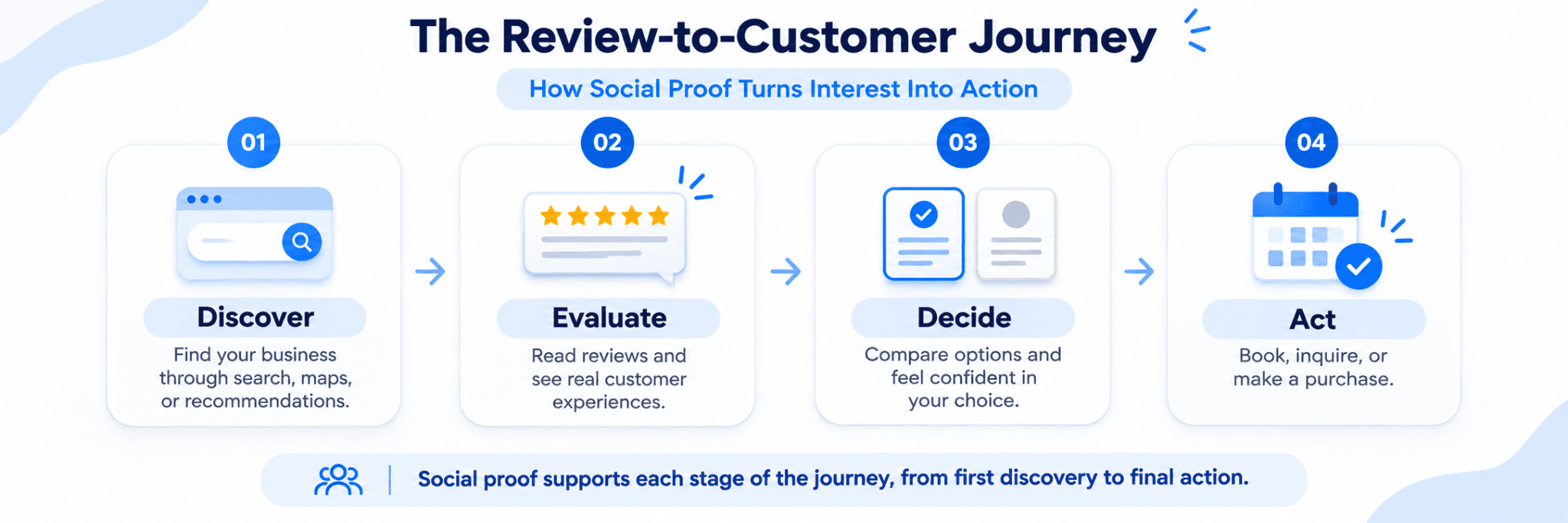
Consider a homeowner looking for a carpet cleaning service.
They discover two businesses with similar ratings. One displays generic five-star comments. The other highlights reviews discussing stain removal, punctuality, pricing transparency, and before-and-after results.
The second business provides more information for the customer's specific decision.
The lesson: A review becomes more persuasive when it answers something a potential customer is already wondering.
How to Turn Customer Reviews Into Sales
1. Match Customer Reviews to the Questions Buyers Actually Ask
Not every review serves the same purpose.
A comment saying "Amazing service!" communicates satisfaction. A review explaining how a plumber handled an emergency repair, arrived on time, and explained the charges provides evidence that helps someone choose.
Businesses should organize customer feedback around buying concerns.
Business | Customer concern | Review to highlight |
Real estate agency | Can this agent handle my situation? | First-time buyer or relocation experience |
Restaurant | Is the food and experience worth it? | Specific dishes, service, and atmosphere |
Cleaning company | Will they deliver reliable results? | Detailed cleaning outcomes and professionalism |
Fitness studio | Is this suitable for beginners? | First-class experience and instructor support |
Hair salon | Can they achieve the style I want? | Specific treatments and customer results |
Start by reviewing your existing testimonials and identifying recurring themes.
Group them by service, customer type, or problem solved. Then place those reviews beside the information customers use to make decisions.
For example, a real estate agent's relocation page should feature relevant relocation experiences rather than unrelated testimonials about selling investment properties.
2. Put Social Proof Where Customers Make Decisions
A five-star review buried on a third-party platform does little for someone already browsing your service page.
Instead of treating reviews as a separate marketing asset, incorporate them into your existing customer journey.
Customer touchpoint | Recommended social proof |
Homepage | Strong overview of customer satisfaction |
Service pages | Reviews specific to that service |
Booking page | Short testimonials addressing common concerns |
Social media | Customer stories and video testimonials |
Email signature | Link to a review or testimonial page |
Sales conversations | Reviews from customers with similar needs |
Avoid displaying the same testimonial everywhere. Different pages attract customers with different questions.
Practical example: A cleaning company advertising move-out cleaning should feature move-out cleaning reviews on that landing page, not testimonials about routine office cleaning.
[Insert image: Service page without testimonials vs. service page with relevant reviews and a booking button]
3. Stop Making Customers Search Across Multiple Review Platforms
A local business might have Google reviews, Yelp recommendations, Facebook feedback, and video testimonials shared on Instagram.
Each platform contributes something different, but asking customers to visit every platform creates unnecessary effort.
A more practical approach is to build a single, accessible destination where potential customers can explore different types of social proof.
For example, a restaurant could present:
- Google reviews highlighting overall customer satisfaction.
- Yelp reviews discussing food and service.
- Instagram videos showing actual dining experiences.
- Customer testimonials about special occasions.
- A direct link to its menu or reservation page.
This gives customers multiple ways to evaluate the business without repeatedly searching for information.
With ReviewShare, businesses can bring reviews and social content together on one shareable page, organize customer feedback into groups, and share that page through websites, social profiles, emails, or direct conversations.
The objective isn't to replace original review platforms. It's to make existing customer experiences easier to discover and evaluate.
4. Use Customer Reviews to Address Purchase Objections
Customers rarely make decisions based on star ratings alone.
They also consider risk: Will the service be reliable? Is the price justified? Will the experience match expectations?
Detailed customer testimonials can answer those concerns more convincingly than generic promotional claims.
Try this simple objection-to-review method:
- Identify the three questions customers ask most often before buying.
- Find genuine reviews that directly address those questions.
- Feature those reviews on the relevant service or sales page.
- Place a clear next step immediately after the supporting evidence.
For example, if customers frequently ask whether a fitness studio welcomes beginners, highlight authentic reviews describing first sessions, instructor support, and the learning environment.
Don't edit reviews to invent details or remove context that changes their meaning. Accurate attribution and permission for republishing should remain part of the process.
5. Make the Next Step Obvious
Social proof builds confidence. A clear call to action helps customers act on that confidence.
The right action depends on the service and the customer's readiness.
Business type | Useful next step |
Restaurant | View menu or reserve a table |
Realtor | Schedule a consultation |
Cleaning company | Request a quote |
Fitness studio | Book a trial class |
Salon | View services and book an appointment |
Place the call to action close to relevant customer feedback, but avoid interrupting the review-reading experience with repeated buttons.
A customer who has just read about a successful home-cleaning experience should have a straightforward way to request that same service.
How to Measure Whether Your Reviews Are Generating Customers
More review views don't necessarily mean more sales.
To understand whether your social proof strategy is working, measure the actions that follow review engagement.
Metric | What it tells you |
Review page visits | How many people reach your social proof |
Booking or contact clicks | Whether visitors take the next step |
Inquiry conversion rate | How many visitors become leads |
Completed bookings | Whether interest becomes business |
Lead source | Which channels introduce valuable customers |
Example:
Suppose a cleaning company's testimonial page receives 400 visits in one month. Twenty-four visitors submit an inquiry, and six become paying customers.
Its visitor-to-inquiry conversion rate is:
24 ÷ 400 × 100 = 6%
Its visitor-to-customer conversion rate is:
6 ÷ 400 × 100 = 1.5%
These are illustrative figures, not industry benchmarks.
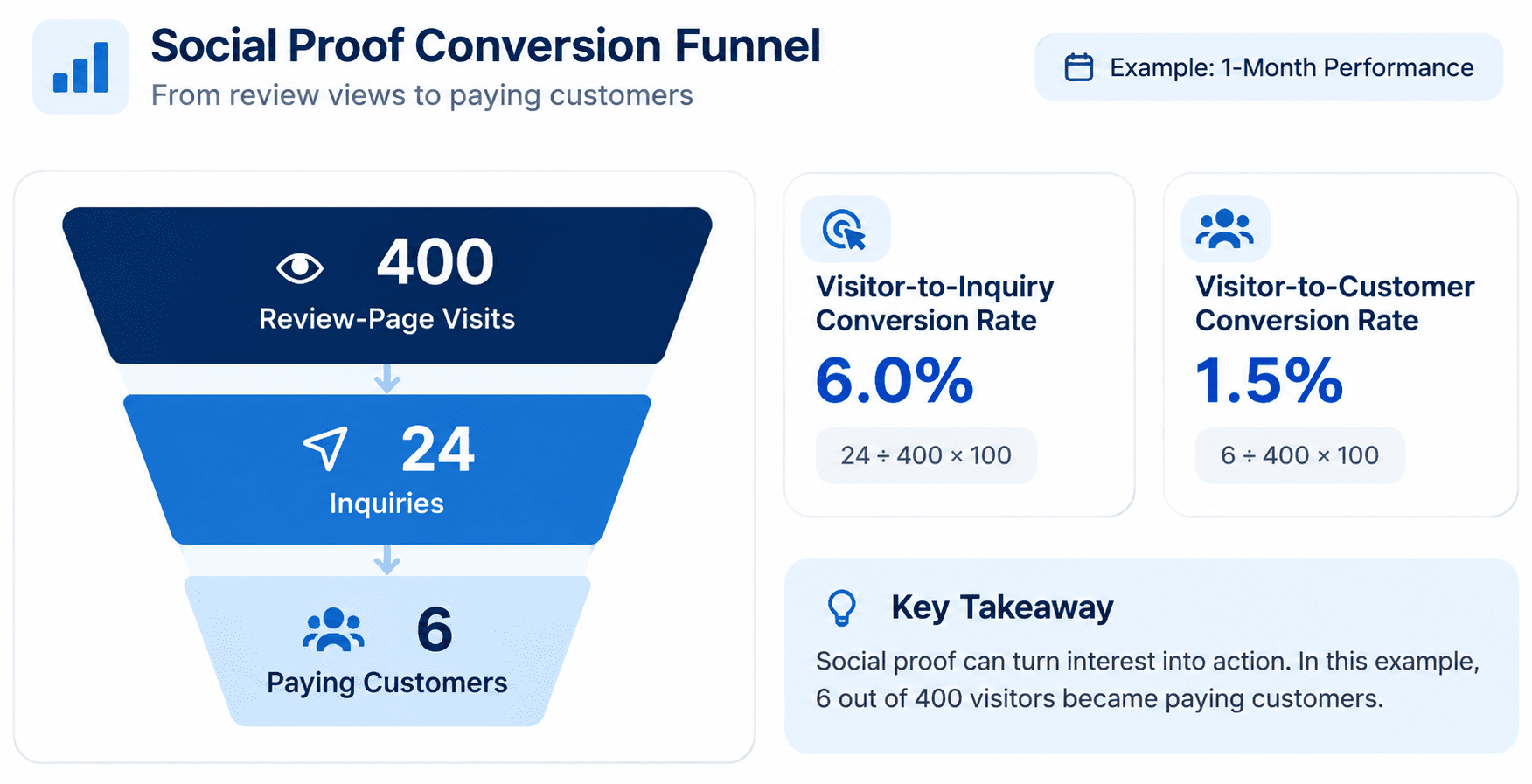
To evaluate performance, compare similar periods and traffic sources. A rise in conversions could reflect better social proof, stronger offers, seasonal demand, or several factors working together.
For a more reliable test, compare a service page with and without relevant testimonials while keeping the offer, traffic source, and booking process as consistent as possible.
A 30-Day Plan to Make Your Customer Reviews Work Harder
You don't need to overhaul your entire marketing strategy. Start with one service and one customer journey.
Timeline | Action | Outcome to check |
Week 1 | Audit existing reviews and identify common customer concerns | Relevant testimonials selected |
Week 2 | Add reviews to a priority service page | Review placement completed |
Week 3 | Share the page through social media, email, and customer conversations | Referral visits and clicks |
Week 4 | Review inquiries and booking data | Initial conversion performance |
Start with the service that receives the most inquiries or generates the highest-value customers.
Once you've identified a useful approach, apply it to other services rather than making every change at once.
Common Mistakes That Weaken Your Social Proof
Even businesses with excellent reputations make mistakes when presenting customer feedback.
- Featuring only perfect ratings: An exclusively flawless presentation can feel less informative than a balanced collection of authentic experiences.
- Using outdated testimonials: Recent reviews provide more current evidence of service quality.
- Showing irrelevant feedback: A review should relate to the product, service, or concern being evaluated.
- Ignoring negative feedback: Thoughtful responses demonstrate how a business handles problems.
- Measuring only review volume: More reviews are valuable, but inquiries and completed sales reveal more about business outcomes.
The goal isn't to make every customer review look impressive. It's to make genuine customer experiences useful to the people evaluating your business.
Explore ReviewShare and put your existing social proof to work.
FAQs
Why does my business have good Google reviews but few customers?
Positive Google reviews don't guarantee new customers. Low search visibility, limited website traffic, unclear service information, strong competition, or a difficult booking process can all reduce conversions. Check Google Business Profile interactions, website visits, inquiries, and completed bookings to identify where potential customers stop progressing.
How can small businesses turn Google reviews into more sales?
Start by highlighting relevant Google reviews on appropriate service pages, where permitted by Google's policies. Connect customer feedback to common purchasing concerns, provide clear contact or booking options, and measure subsequent inquiries. Reviews support purchase decisions most effectively when paired with useful service information and a straightforward next step.
Where should I display customer testimonials on my website?
Display testimonials near the decisions they support. Use broad customer feedback on the homepage, service-specific reviews on relevant landing pages, and concise reassurance near booking or inquiry sections. Maintain access to the original source when possible, and ensure testimonials are authentic and presented accurately.
Do customer reviews actually increase conversion rates?
Customer reviews can influence conversion rates by reducing uncertainty and providing evidence from previous buyers. Northwestern University's Spiegel Research Center found substantial differences in purchase likelihood between products with and without reviews. However, the impact varies by business category, customer intent, review credibility, and how prominently reviews are displayed.
How do I know whether my customer reviews are bringing in new customers?
Track review-page visits, referral traffic, contact clicks, inquiries, and completed purchases. Use tagged links where appropriate, website analytics, and a consistent lead-source question during booking. Compare results over time, and distinguish correlation from causation before attributing increased sales entirely to reviews.