
Best Loox Competitors for Customer Reviews Beyond Shopify
Marketing & Growth Associate
On this page▾
Loox is a popular review app for Shopify merchants, particularly those who want to collect customer photos, videos, and product ratings. But when businesses start comparing Loox competitors, they're not always looking for another Shopify app.
Some need more affordable product review software. Others want reviews that work across multiple ecommerce platforms. And for businesses selling services rather than products, the challenge is different: customer feedback often lives on Google, Yelp, Zillow, or other platforms instead of an online storefront.
The right alternative depends on what you're selling, where customers leave feedback, and how you want to use those reviews.
This guide compares six Loox competitors, explains where each platform fits, and explores what businesses should consider before switching.
What Is Loox, and When Should You Consider an Alternative?
Loox is a product review application built for Shopify. It helps merchants collect customer feedback after purchases and display it through review widgets, ratings, and visual galleries.
Its strengths include automated review requests, photo and video testimonials, shoppable review displays, and ecommerce integrations.
For a clothing retailer, customer photographs can show how an item fits. For a furniture brand, they can demonstrate how a product looks in an actual home.
These are valuable applications of visual reviews.
However, businesses may explore alternatives when they need different pricing, integrations with other ecommerce platforms, more advanced review management, or a way to display customer experiences that aren't connected to individual products.
Before comparing tools, it's worth identifying whether your priority is product reviews, company reviews, or broader business reputation management.
6 Best Loox Competitors for Different Business Needs
Not every platform below is a direct feature-for-feature replacement for Loox. Some compete in Shopify product reviews, while others serve businesses with different customer feedback requirements.
1. Judge.me — Best for Affordable Shopify Product Reviews
Judge.me is one of the more direct Loox alternatives for Shopify merchants.
It provides tools for collecting written reviews, customer photographs, videos, and product ratings. Merchants can automate review requests, import existing feedback, and display reviews throughout their storefronts.
Its free plan makes it particularly relevant to smaller stores that want essential review features without immediately committing to a larger monthly subscription.
Notable features:
- Automated product review requests
- Photo and video reviews
- Customizable review widgets
- Review import and export
- Product ratings and review displays
Best for: Shopify stores looking for affordable review collection and display.
What to consider: Judge.me is primarily designed around ecommerce workflows. Businesses that don't sell products online may find its product-centered features less relevant.
2. Yotpo — Best for Established Ecommerce Brands
Yotpo is an ecommerce-focused platform offering customer review collection, visual user-generated content, and review management capabilities.
For brands managing large product catalogs, reviews aren't only useful for convincing shoppers. They can also reveal recurring product complaints, differences in customer expectations, and opportunities to improve product descriptions.
Yotpo provides tools for analyzing and presenting that feedback across supported ecommerce channels.
Notable features:
- Automated review collection
- Photo and video testimonials
- Review analytics and AI-powered features
- Review syndication
- Ecommerce integrations
Best for: Established online retailers that need more advanced review management.
What to consider: Businesses should compare plan limits and feature availability carefully. Advanced capabilities may be unnecessary for smaller stores with straightforward review requirements.
3. Fera — Best for Visual Reviews Across Ecommerce Platforms
Fera helps online retailers collect and display product reviews, including customer photos and videos.
It supports several ecommerce environments, making it relevant to merchants who want flexibility beyond a Shopify-only application.
Visual reviews are particularly useful for products where appearance, fit, or real-world use influence purchasing decisions.
For example, a home decor retailer can use customer photographs to show how products look in different rooms rather than relying entirely on professional product photography.
Notable features:
- Photo and video review collection
- Automated review requests
- Customizable review displays
- Review imports from supported sources
- Ecommerce platform integrations
Best for: Online stores prioritizing visual customer feedback and storefront compatibility.
What to consider: Integration availability differs between platforms. Check support for your specific website system before planning a migration.
4. REVIEWS.io — Best for Multi-Channel Ecommerce Reviews
REVIEWS.io supports both product reviews and company reviews, making it relevant to businesses managing customer feedback across multiple sales channels.
It offers review collection, visual content, website widgets, and integrations with popular ecommerce systems.
A retailer operating several storefronts may need a more consistent way to manage feedback without maintaining entirely separate review processes for each website.
REVIEWS.io is worth evaluating for that type of operation.
Notable features:
- Product and company reviews
- Photo and video testimonials
- Review collection automation
- Website review widgets
- Multiple ecommerce integrations
Best for: Ecommerce brands operating across different storefronts or sales channels.
What to consider: Review migration, integration capabilities, and advanced features can depend on the selected plan.
5. ReviewShare — Best for Customer Reviews Beyond Ecommerce
ReviewShare approaches customer feedback differently from traditional Shopify review apps.
Rather than focusing on individual products and order-based review requests, ReviewShare helps businesses present reviews, testimonials, and selected social content through a branded, shareable page.
This becomes particularly relevant when customer feedback exists across several independent platforms.
A real estate professional may receive reviews on Google and Zillow. A restaurant might have customer recommendations on Google, Yelp, and TripAdvisor. A home cleaning business may have detailed reviews describing different services.
These businesses aren't necessarily looking for product ratings or shoppable galleries. They need a practical way to present their existing reputation to prospective customers.
ReviewShare supports that through review aggregation, branded pages, and website displays.
Notable features:
- Reviews from supported sources, including Google, Yelp, Zillow, and TripAdvisor
- Branded, shareable review pages
- Review Groups for different services or topics
- Customer feedback collection through forms, links, and QR codes
- Website review widgets
- Selected social content and video testimonials
Where ReviewShare Makes More Sense Than a Shopify Review App
Consider a residential cleaning company offering deep cleaning, carpet cleaning, and move-out cleaning.
Its customers don't usually select services through product listings containing star ratings and customer photographs.
Instead, they evaluate the company's reliability, professionalism, and experience with the particular service they need.
ReviewShare's Review Groups allow the business to organize feedback around those services.
A potential customer interested in move-out cleaning can explore relevant experiences instead of searching through unrelated testimonials.
The same approach applies to real estate agents organizing reviews from buyers and sellers, or fitness studios highlighting different training experiences.
Businesses can also display selected reviews through website widgets or share their branded page during customer conversations.
Important distinction: ReviewShare isn't intended to replace every Shopify-specific capability offered by Loox. Businesses that depend on automated product review requests, product-specific galleries, and ecommerce referral features should prioritize platforms built for those workflows.
ReviewShare is more relevant when the goal is to present a business's broader customer reputation.
Businesses comparing testimonial platforms rather than ecommerce review apps can also explore our ReviewShare vs. Senja comparison, which examines how the two platforms approach testimonial collection, organization, and sharing.
6. Trustpilot — Best for Public Company Reviews
Trustpilot is a public review platform where customers share experiences with businesses.
Unlike product review applications that primarily operate within a merchant's website, Trustpilot maintains public business profiles where consumers can read and submit reviews.
Its business tools also support review invitations, feedback management, and website displays.
For businesses seeking an independent public review presence, this model serves a different purpose from Shopify product review software.
Notable features:
- Public company review profiles
- Customer review invitations
- Business star ratings
- Feedback management
- Review display integrations
Best for: Businesses that want to develop and manage a public company review presence.
What to consider: Trustpilot is a review destination as well as a software provider. It isn't designed to function as a universal aggregator for reviews from every external platform.
Loox Alternatives Compared: Which Platform Fits Your Business?
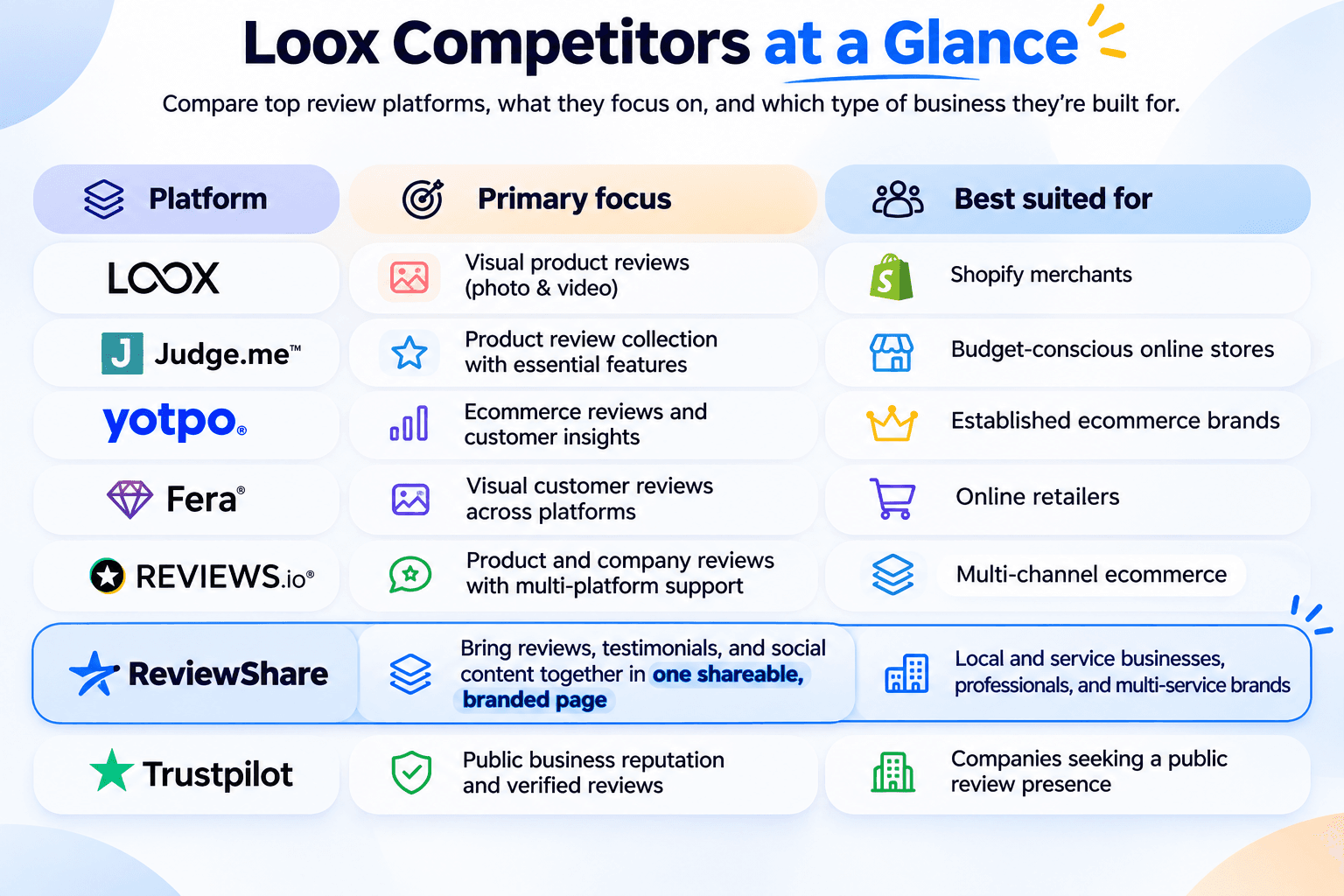
An online retailer may prioritize verified purchases and product ratings. A service business may care more about detailed customer experiences and the ability to present them across its website and other marketing channels.
Product Reviews vs. Business Reviews: Why the Difference Matters
Product reviews and business reviews are often grouped together under the term customer reviews, but they answer different questions.
A product review evaluates a particular item. Customers might discuss its quality, appearance, durability, or whether it matches the product description.
A business review evaluates the experience of dealing with a company. It might describe communication, reliability, professionalism, customer support, or service outcomes.
For ecommerce stores, both types of feedback can be valuable.
A customer purchasing a laptop may want product reviews about battery life and performance, alongside company reviews about shipping and returns.
For service businesses, company-level feedback often carries more practical relevance because the customer is choosing a provider rather than a physical product.
This is why selecting review software solely on the number of available widgets or integrations can lead to the wrong decision.
Start with the customer decision your reviews need to support. Then evaluate which platform is designed for that purpose.
What Should You Check Before Switching From Loox?
Switching review software affects more than the appearance of your website. Existing customer feedback, review verification, and integrations may also be affected.
1. Can You Transfer Existing Reviews?
Check whether the new platform supports importing your existing reviews.
More importantly, verify which information transfers.
Written feedback may be relatively straightforward to export, while photographs, videos, timestamps, and product associations can require additional steps.
Before cancelling your current subscription, export a backup and test a small sample of reviews in the new platform.
2. Will Verified-Purchase Labels Be Preserved?
Some review platforms distinguish between verified purchasers and other reviewers.
An imported review may not automatically retain its verification status if the new system cannot match it to the original order.
Ask the provider how verification works for migrated reviews, especially if verified-purchase labels are important to your customers.
3. Does the Platform Support Your Website?
A review tool may advertise integrations with multiple website builders, but feature availability can differ.
Confirm that your preferred widgets, review collection methods, and integrations work on your actual website platform.
For businesses without ecommerce stores, check whether the platform requires product catalogs or purchase records.
4. How Much Will the Features You Need Actually Cost?
Review software pricing may depend on order volume, review requests, advanced widgets, integrations, or additional services.
Compare the features included in each plan rather than choosing based on the lowest advertised price.
A free plan with limited capabilities isn't necessarily better value than a paid plan that covers your essential requirements.
5. What Happens to Reviews Already Displayed on Your Website?
Before removing an existing review app, identify every place its widgets appear.
That might include product pages, landing pages, homepages, or dedicated testimonial sections.
Replacing those displays without checking their placement can leave empty sections or disrupt the customer experience.
Plan the transition so your website continues presenting relevant feedback throughout the migration.
Which Loox Competitor Should You Choose?
There isn't one review platform that fits every business.
If you're running a Shopify store and primarily need affordable product reviews, Judge.me is worth exploring.
For established ecommerce brands with advanced review requirements, Yotpo provides a broader range of capabilities.
Fera and REVIEWS.io deserve consideration when visual reviews and compatibility with different ecommerce platforms are priorities.
Trustpilot is relevant for businesses interested in public company reviews.
For businesses whose customer feedback extends beyond ecommerce, ReviewShare offers a different approach.
It brings reviews and testimonials from supported sources into a branded page that businesses can share through websites, social profiles, emails, and customer conversations.
The best choice ultimately depends on whether customers are evaluating a product, an online store, or the business behind the experience.
Explore ReviewShare — Try It for Free
FAQs
1. What is the best Loox alternative for businesses that don't use Shopify?
For ecommerce businesses using other storefront systems, REVIEWS.io and Fera are worth evaluating because they support multiple ecommerce environments. For service providers and local businesses without product catalogs, ReviewShare offers a way to present customer reviews and testimonials from supported sources through a branded page.
2. Can I display Google reviews and customer testimonials on my website without Shopify?
Yes. Shopify isn't required to display customer feedback on a business website. ReviewShare provides website widgets and branded review pages that support reviews from sources such as Google and Yelp. Businesses should ensure their review displays follow the applicable source-platform policies.
3. Is there a way to combine reviews from multiple platforms into one link?
Yes. ReviewShare supports bringing customer feedback from supported platforms, including Google, Yelp, Zillow, and TripAdvisor, into one shareable page. This is particularly useful for businesses whose customers leave reviews across different directories rather than through a single ecommerce store.
4. Are photo reviews more effective than star ratings?
They serve different purposes. Photo reviews provide visual evidence of how a product looks or performs in real situations, making them especially useful for categories such as fashion, furniture, and home decor. Star ratings support quick comparisons, while detailed written reviews provide context. The most useful format depends on what customers need to evaluate before purchasing.
5. Will adding customer reviews to my website make Google show star ratings in search results?
Not automatically. Google determines eligibility for review rich results according to its structured data and review snippet policies. In particular, self-serving reviews about a business displayed on that business's own website generally aren't eligible for review stars in Google Search. Review widgets should primarily be used to provide useful information to website visitors, not as a guarantee of enhanced search results.